

The Heart Arrives First
A dream day in Languedoc – honey, garlic, cold river water, and what it feels like when the life you imagined turns out to be real.

Right now, I am driving south through Europe.
Denmark behind me.
France ahead.
The motorway stretches forward in long grey lines while petrol stations, trucks, and fields slide past the windows. Clark is asleep beside me. Coffee in a paper cup. Music low. My hands on the steering wheel.
But in my mind, I am already there.
Already in Maison Violette.
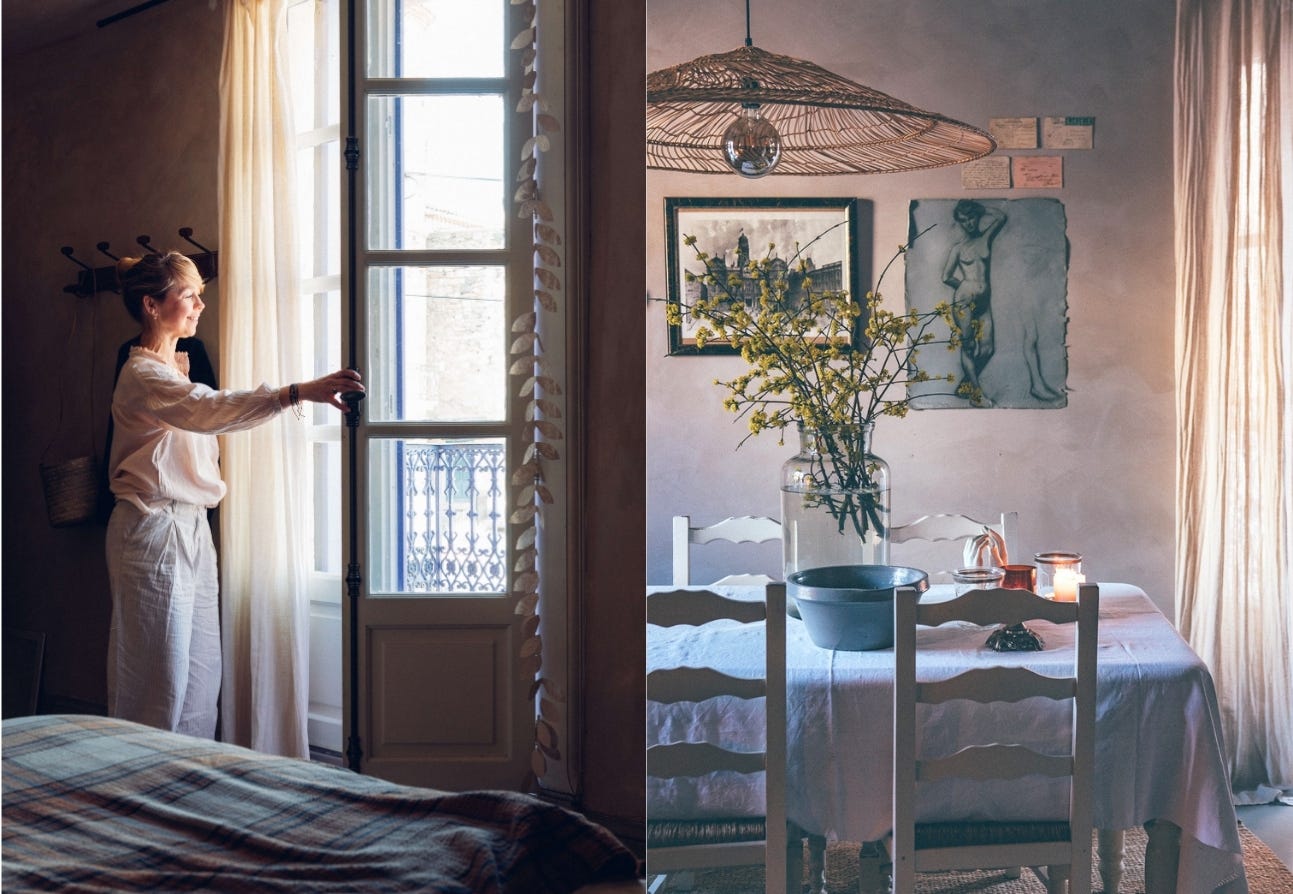
The curtains move before I am fully awake.
A breath of air through the shutters – cool, carrying something green and sun-warmed and faintly dusty. The smell of stone. Of lavender from somewhere I cannot see. I lie still and let it arrive, this morning, this particular quality of light that exists nowhere else in the world quite the way it does here, pressing itself in pale gold bars across the whitewashed wall.
I am fifty-five years old, and I have chosen this. That still surprises me, some mornings. That I said yes to the leap. That I am here.
I tiptoe down the staircase in bare feet, each step a soft creak of old wood. The kitchen is cool and dim. I grind the coffee, listening to the sound of it, unhurried. While it brews, I cut fruit – a peach that gives slightly under the knife, a handful of dark cherries, a fig split open to its soft red interior. I spoon cold yoghurt into a bowl and scatter almonds on top, drizzle a little honey that falls in one slow, amber thread.
I eat standing at the open window and send a quiet thought home to my mother.
The first time I have left Denmark since she was hospitalised in February.
The square below is waking slowly. A chair scraping against stone. Someone carrying bread home in paper. Pigeons moving in small determined circles. Life continuing, gently, while part of my heart is still elsewhere for a moment.
Below, the square is waking. A chair scraping on stone. A woman crossing with a bag of bread under her arm. The pigeons doing what pigeons do. Somewhere above me, a shutter swings open, and a man leans out and looks at the sky. He smiles briefly at no one in particular, then steps back inside.
I pack my basket. Clip Clark’s lead. Drive to the market.
A quiet little invitation: for the next 72 hours, a new annual membership at €65 includes The Sensory Storytelling Masterclass as a complimentary gift – priced €67 for everyone else. Along with a thriving community, seasonal letters, behind-the-scenes life in France, recipes, creative business tools, and inspiration for how a flourishing midlife can be designed.
Your access link will find you in July.
The offer expires on May 27th at midnight 🌿
It reaches you before you see it.
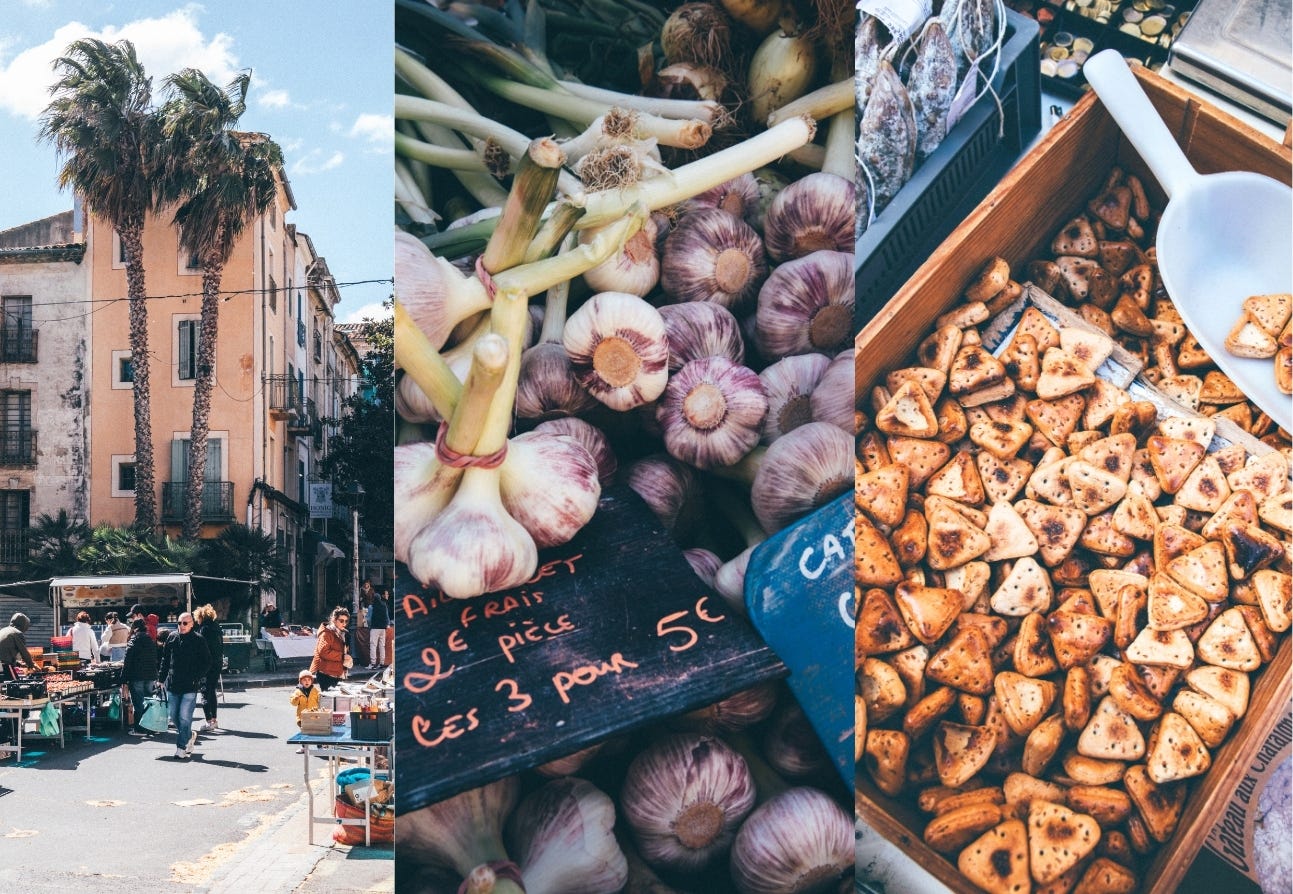
Garlic first – sharp and papery, a whole stand full of it, braided into thick ropes that hang from the stall frames. Then cut herbs. Warm bread. The dark, briny edge of oysters on ice. I stop at the entrance and simply stand for a moment, breathing it in, because this is one of the things I have learned here: to stop. To actually arrive somewhere before moving through it.
The market is loud with French, fast and musical, full of sounds I am still learning to catch. A vendor calls out – something about tomatoes, I think, or perhaps about the weather. An old man laughs at his own joke. A child pulls at her mother’s sleeve. I understand perhaps two words in four, and it doesn’t matter at all. There is a freedom in not understanding everything. A permission to simply watch, to receive, to be entirely present without the noise of comprehension getting in the way.
I buy tomatoes, heavy and warm, still carrying the heat of wherever they grew. A rough wedge of sheep’s cheese. A bunch of thyme that releases its smell the moment I touch it, sharp and resinous, coating my fingers. Clark sits beside me with great dignity and watches a man at a café table work his way through a croque madame. His eyes do not leave the plate.
At the seafood bar, a group of people are eating oysters at ten in the morning, white wine in hand, the sea-cold shells held loosely, lemon squeezed and gone. I watch them with recognition. The understanding that this is what it looks like when people have decided to actually live the hours they are given.
I am learning that too. Maybe later than I should have. But I am learning.
I drive south toward the sea.
The road cuts through vineyards that stretch to the horizon, the vines low and gnarled, the soil pale as chalk. Olive trees stand at the edges with their silvery leaves catching the light and releasing it. The window is open, and the air is warm on my arm and smells of rosemary and hot tarmac and something floral I still haven’t identified, one of the small mysteries of this landscape I am slowly, devotedly collecting.
I think about the book I am writing. About this life. About what it means to arrive at the middle of your own story and feel, against all expectations, not smaller but larger. More curious. More awake. I spent years building something solid and good and mine. And then I opened a door I hadn’t known was there – and walked through it into a stone house in a medieval village in the south of France, into a version of myself I am still discovering.
That is what no one tells you about midlife. That it can feel like the beginning.
I park at the harbour. The sea is flat and blue-green and almost unbearably still. Clark pulls ahead on his lead, and I let him. I buy an ice cream – lavender, because here you can, because here that is simply what ice cream is – and sit on a low wall with the sun pressing warmly on my face and the smell of salt coming off the water in slow waves.
Then a café. A latte that arrives in a wide white cup, strong and dark beneath the foam. I open my book – Sue Monk Kidd, on creativity and surrender, on what happens when you stop trying to direct your life and begin instead to listen to it. I read a paragraph and put the book face-down in my lap and look at the water.
This is mindfulness, I think. Not the kind you practice on a mat. The kind that arrives naturally when your life is strange enough and beautiful enough that you cannot afford to be anywhere but here.
I think about Denmark. The life waiting for me there, solid and familiar and beloved. The particular comfort of knowing where everything is, of being fluent in your own surroundings. I will return to it, and I will see it differently. I always do. As though France has cleaned my eyes somehow – rinsed away the film of the familiar so that I can see the extraordinary in the ordinary again.
But that is later.
Right now: the harbour. The latte. The lavender ice cream melting slightly over my fingers. Clark warm against my foot.
On the way home I stop where the road runs alongside a river.
I take off my sandals and walk down the bank and step in. The cold is immediate and total – the kind that makes you breathe in sharply, that travels straight up through the soles of your feet and clears every thought you were carrying. The water is clear enough to see the stones at the bottom, smooth and pale, shifting gently in the current. I stand there for a long moment, cold to the knee, the sun hot on my shoulders, the river moving quietly around me.
I am a woman in her fifties standing in a river in the south of France, entirely alone, entirely present, entirely here.
There are many ways to measure a life. This is one of them.
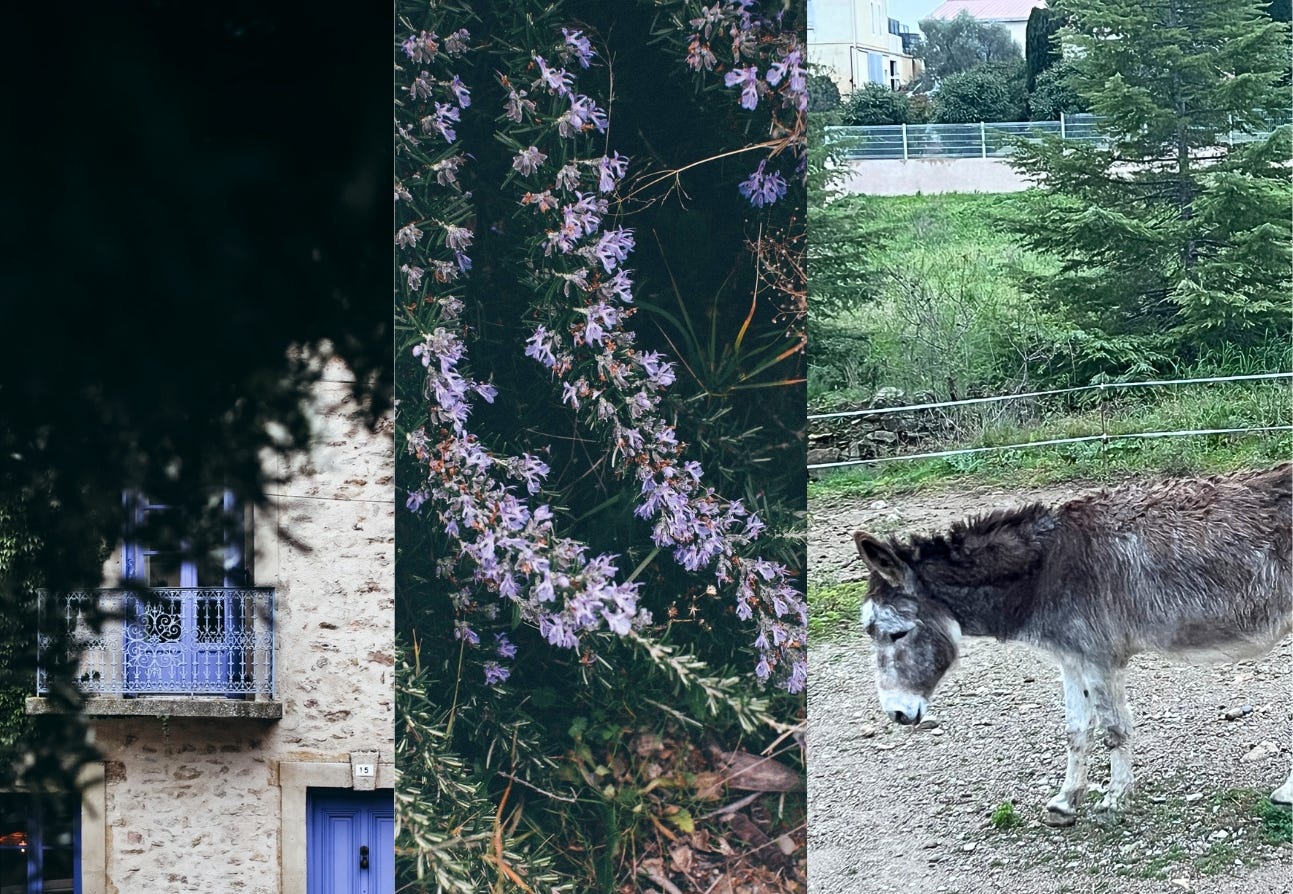
Back in the village, Clark leads me to the gate he knows. The donkey is waiting – unhurried, warm-smelling, with the mild philosophical expression donkeys always seem to wear. They regard each other. I take my scissors from my bag and cut a few rosemary branches from the bushes at the vineyard’s edge, the stems woody and fragrant between my fingers. The smell rises immediately in the warm air.
On the way back, a neighbour stops to talk. I understand more than I did last month. Small victories.
Later, the rosemary stands in a jar on the kitchen table beside the olive branches, filling the kitchen with the smell of the south.
The shutters are open to the square, and the light is changing now, the afternoon gold going amber, the shadows lengthening across the stone. I pour a glass of cold rosé and sit with it, and do not reach for my phone. I listen to the square – a child, a scooter, two women talking – and feel the day settling into me, all its textures and smells and tastes, the cold river, the warm sea, the garlic and thyme and lavender and coffee.
This is what I came for. I fell in love with this house before I ever stood inside it – first through a screen, then for real, my hand on the old stone, knowing immediately. But what I came to understand, slowly, is that the house was never only a house. It was a mirror. A reflection of something I had been carrying inside me for years – that inner realm of beauty, stillness, and aliveness that I return to again and again to remember who I am.
Maison Violette chose me as much as I chose it. And stepping through its door felt less like buying a property and more like recognising myself.
The expansion. The feeling of becoming someone slightly larger than the person who arrived. The daily practice of curiosity, of noticing, of choosing again and again to be awake to my own life.
It asks courage, this kind of living. And trust. And a willingness to not yet know how it ends.
But oh – what a story it is making.
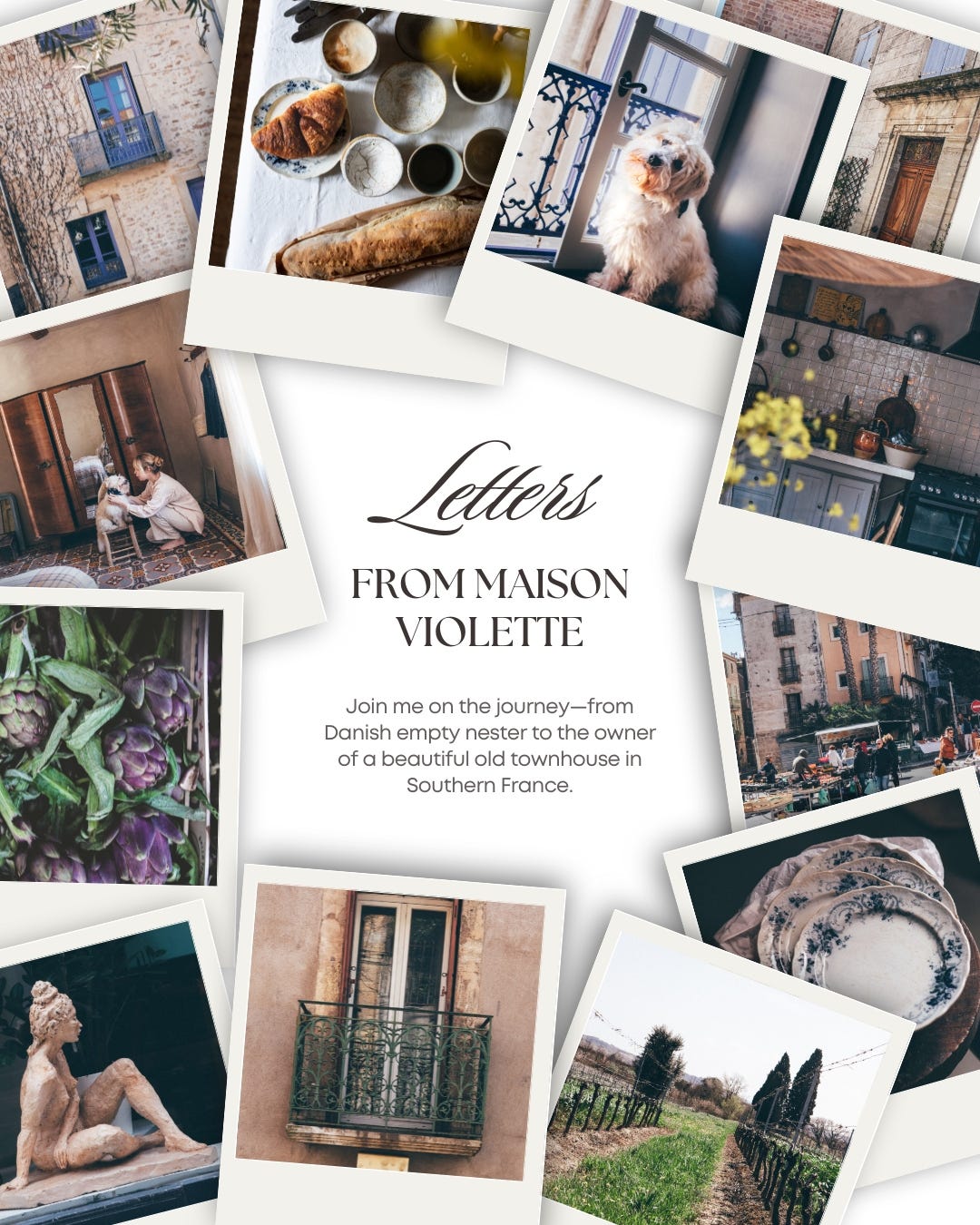
But this is not only a story about a day in the south of France.
It is also, quietly, an invitation.
Because if something in these words transported you – if you could feel the cold of the river, smell the thyme, taste the lavender ice cream – then you already understand what sensory storytelling can do. And I have spent thirty years learning how to teach it.
At the beginning of July, I am releasing The Sensory Storytelling Masterclass – everything I know about writing that makes your reader feel, see, smell, hear, and remember. Writing that doesn’t describe a moment, but rebuilds it so completely that the reader forgets they are reading at all. It will be priced at €67.
But for the next 72 hours, something quietly generous is available.
New annual members of Letters from Maison Violette join for €65, and receive the masterclass as a complimentary gift when it opens in July. A private email with your personal access link will find you the moment the doors open. No hunting. No missing it.
Your annual membership price remains yours too, whatever I raise my rates to in the future. You came early. That matters to me.
If something in you is quietly saying yes – the link is above. The door is open for two more days, and there is a seat at the table with your name on it🌿
With love from Maison Violette,

Where exactly is Maison Violette?
Such a pleasure to read.